Demolition does not have to mean treating every material that comes out of a building as waste. With the right planning, some materials may be suitable for reuse, recycling, or other forms of recovery before the remainder is sent for disposal.
Green demolition focuses on identifying those opportunities early and managing materials more deliberately as work progresses. For property owners, developers, contractors, and other project stakeholders, this approach can reduce the amount of construction waste requiring disposal without assuming that every component can or should be recovered.
Green demolition starts by looking at what is actually present in the structure. Different materials may require different handling methods, and some may have value beyond the demolition site.
Salvaging, demolition recycling, material separation, and responsible disposal work best as parts of the same plan rather than as separate decisions made after debris has already been mixed together.
A pre-demolition review can help identify which materials may be suitable for salvage, reuse, recycling, or conventional disposal. The goal is to understand the material mix before removal begins so crews can plan how different materials will be handled.
Recovery opportunities depend on the building, the condition of individual components, project scope, and available facilities or reuse options. Identifying those factors early can make separation more deliberate once demolition starts and reduce the need to sort through mixed debris later.
Salvaging involves removing materials or components that may still have practical value rather than immediately treating them as waste. Depending on the project, examples could include doors, fixtures, lumber, or other building components that can be removed safely and remain in usable condition.
Not every item is worth recovering. Condition, accessibility, project schedule, safe removal requirements, and available reuse opportunities all affect whether salvaging is practical.
When suitable materials can be removed intact, salvage offers one way to reduce unnecessary waste before heavier demolition work begins.
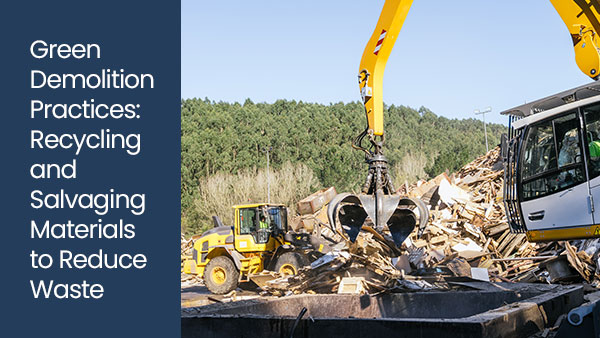
Mixed debris is generally harder to manage than clearly separated material streams. Sorting materials as demolition progresses can make it easier to direct recyclable materials toward appropriate processing facilities.
Depending on the project and local options, common streams may include:
The exact sorting plan should reflect the materials present on site. A project containing large quantities of concrete, for example, may require a different staging and handling approach than one involving significant wood or metal.
Separating materials only helps if those streams remain reasonably organized. When recyclable debris becomes mixed with unrelated waste or contaminants, recovery can become more difficult or, in some cases, no longer practical.
Clearly designated collection areas and containers can help crews keep materials apart. Site supervisors and material handlers should also understand which debris belongs in each stream so sorting expectations remain consistent throughout the job.
That does not mean every separated material will ultimately be recycled. Acceptance still depends on the receiving facility, material condition, and other project-specific factors.
A material is only a realistic recycling candidate if there is somewhere appropriate to take it. Before demolition begins, project teams should confirm which facilities accept the materials expected on site and what requirements apply.
Facilities may differ in what they accept, how materials must be sorted, and what condition they need to be in when delivered. Confirming these details in advance helps prevent crews from preparing a material stream that cannot be accepted as expected.
This planning step also helps connect on-site sorting with the actual construction waste recycling options available to the project.
Selective demolition takes a more deliberate approach to removing parts of a building. Instead of treating the structure as one mixed debris stream, particular materials or components may be removed separately where conditions allow.
This can create better opportunities for salvage and sorting because materials are separated before they become mixed with surrounding debris. It can be especially useful when specific components have been identified for recovery during the pre-demolition assessment.
Selective demolition is not automatically the right method for every project. Building conditions, safety requirements, schedule, site access, and recovery priorities all influence whether the approach is practical.
Even well-planned projects can produce material that cannot reasonably be salvaged or recycled. Damaged materials, contaminated debris, or items without an available recovery route may still require disposal.
Responsible green demolition recognizes that reality. The goal is to reduce avoidable waste, not to claim that disposal can always be eliminated.
Remaining debris should be handled according to applicable project requirements and appropriate disposal practices, with those needs considered as part of the material-management plan from the beginning.
Effective demolition recycling is much easier to organize before crews and equipment begin removing materials. Early planning can identify which materials should be separated, where containers or staging areas will be located, and which recovery options are realistic.
It also gives project stakeholders a common set of expectations. When demolition crews, site supervisors, contractors, and material handlers know which materials are being salvaged, recycled, or disposed of, there is less room for useful materials to become mixed unnecessarily.
Recovery options vary from project to project. Material type and condition matter, but so do contamination, site access, demolition methods, available space for sorting, project timelines, and the capabilities of nearby recycling or recovery facilities.
That is why construction waste recycling should be assessed on a project-specific basis. A material that is practical to recover on one site may be difficult to separate or process on another.
Where relevant, project teams should also confirm facility requirements and applicable waste-management obligations rather than assuming one demolition plan will work everywhere.
Green demolition works best when material recovery is considered before demolition begins. Assessing materials, salvaging suitable components, separating recyclable streams, coordinating with recovery facilities, and planning responsible disposal can all help reduce unnecessary construction waste while keeping the approach realistic for the specific project.
Reach out to MOD Demolition today at 249-449-0018, or click here to get in touch online.
Green demolition is an approach that looks for practical opportunities to recover, reuse, recycle, or responsibly manage materials generated during demolition. The exact methods vary depending on the building, material condition, site requirements, and available recovery options. It does not mean every project can eliminate waste completely.
Salvaging generally means recovering a material or building component so it can be reused in its existing form. Demolition recycling involves sending suitable materials for processing so they can be used again in another form. Both approaches can reduce the amount of debris requiring disposal.
No. Recyclability depends on factors such as material type, condition, contamination, available facilities, and project circumstances. Each material should be assessed individually rather than assuming everything removed from a demolition site has the same recovery option.
Recycling and salvage should ideally be considered during project planning, before materials have been removed and mixed together. Early planning can help identify recovery opportunities, determine how materials should be separated, and establish where recovered materials may be sent.