When inventory, tools, equipment, or seasonal materials start taking over valuable workspace, adding storage can relieve pressure on day-to-day operations. The harder question is deciding what type of storage actually fits the way your business works.
Shipping container storage and conventional self-storage units can both provide extra capacity, but they solve the problem differently. Access frequency, available property space, storage volume, transportation, and how long you need the space can all affect which option makes more sense.
There isn’t one storage format that works best for every business. A better comparison starts with how your staff will use the space and what practical requirements matter most.
Specific unit sizes, security arrangements, access rules, pricing, and storage restrictions vary by provider, so confirm those details before committing to either option.
Begin by estimating what you need to store and how much room it occupies. Larger tools, grouped inventory, supplies, and bulky equipment may suit the open enclosed space offered by a shipping container.
Self-storage facilities may offer a wider selection of smaller storage units, depending on the provider. That can be useful when your requirements are modest, or you want to select a unit size more closely matched to your current volume.
Measure larger items instead of relying on visual estimates. It’s also worth considering whether your storage volume stays fairly consistent or changes substantially throughout the year.
Think about how often employees need to retrieve or return items. A shipping container placed at or near your business can reduce travel time when on-site placement is available and practical.
Self-storage units generally require employees to travel to the storage facility and follow its access procedures. For occasional retrieval, that may not be a major concern. For a team accessing tools or supplies several times a week, the extra trips can become an operational factor.
The Sea Can & Open Storage offering linked below confirms that 20-foot rental containers can be kept within its secured compound or placed off-site at a client’s preferred location, subject to the applicable arrangement.
Shipping containers offer a particular kind of flexibility because they may be placed on a business property when there is enough suitable space and delivery access.
That doesn’t mean a container can simply go anywhere. Property layout, delivery requirements, lease conditions, and applicable local rules should all be checked first.
Self-storage units stay at a fixed facility, so they don’t consume parking, loading, or operating space at your business. That separation can be an advantage for businesses without room to dedicate to a container.
Storage dimensions tell only part of the story. Businesses should also consider how equipment and inventory will physically move into and out of the space.
Door access, vehicle positioning, loading distance, carts, pallets, and the weight or dimensions of stored items can all affect convenience. On-site shipping container storage may reduce repeated transportation when employees frequently move materials between storage and the workplace.
A self-storage facility may be easier for companies that don’t have suitable space or access for container delivery.
Avoid assuming either option is automatically cheaper. Compare the total cost of using the storage arrangement for the length of time you expect to need it.
Rental rates are only one part of the equation. Depending on the provider and setup, businesses may also need to consider delivery, pickup, transportation, insurance, access, or other charges.
Rental duration and capacity can also change the calculation. For longer-term or recurring needs, buying a shipping container may be worth evaluating if the business has an appropriate place to keep it.
Ask providers to explain how their storage areas and individual units or containers are secured. The format alone doesn’t determine the level of protection.
A facility-based self-storage unit may combine site security with an individual locking arrangement. A container placed at your business gives you more control over its physical location, but its security will also depend on your property and the locking setup you use.
The Sea Can & Open Storage service describes its own storage compound as secured. That claim shouldn’t be assumed to apply to containers placed on client-controlled properties.
Temporary project materials or seasonal inventory may require a different arrangement than equipment you expect to store for years.
Compare rental terms, transportation requirements, and how easy it would be to increase, reduce, or relocate your storage. A rented container may suit temporary overflow, while purchasing one could warrant consideration for recurring requirements where suitable property space is available.
The provided Sea Can & Open Storage service offers containers for both rental and purchase.
On-site container storage requires enough physical space for both the container and its delivery. Consider parking, loading areas, employee movement, customer access, and existing site operations before dedicating part of the property to storage.
Lease conditions and local requirements may also affect placement. These should be confirmed before making longer-term arrangements.
Self-storage moves the storage footprint away from your business entirely, which can simplify the decision when usable site space is already limited.
Bring the decision back to your workflow. Shipping container storage may suit businesses that need substantial enclosed capacity and value convenient access near their operations.
Self-storage units may make more sense when on-site space is limited or when keeping stored materials completely separate from the business property is preferable.
Before comparing providers, make a short requirements list covering volume, access frequency, duration, location, budget, and the types of items being stored. That gives you a much stronger basis for choosing than price alone.
Start with what will actually go into storage, how much room it requires, and how often employees need access.
Ask providers about available sizes, rental terms, access arrangements, security measures, delivery and pickup requirements, and restrictions on stored materials. Businesses considering off-site container placement should also confirm whether their property has enough suitable space and access for delivery.
Compare written terms wherever possible. A low headline price doesn’t tell you much if the overall arrangement doesn’t fit your workflow.
The right choice between self-storage units and shipping container storage depends on capacity, access frequency, location, available property space, and how long the storage will be needed. MOD Demolition’s current Sea Can & Open Storage offering includes 20-foot rental containers at its secured facility or off-site, along with 20- and 40-foot containers available for sale.
Reach out to MOD Demolition today at 249-449-0018 or click here to get in touch online.
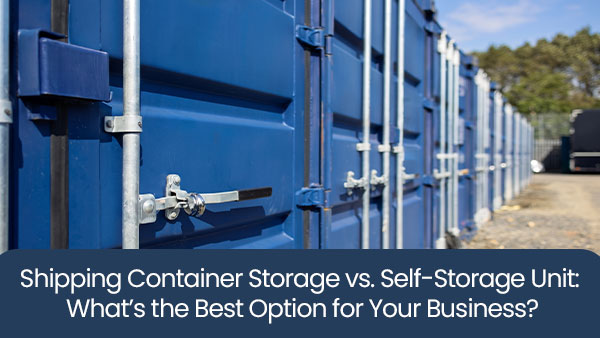
Shipping container storage uses enclosed containers, often called sea cans, to provide additional space for business or personal belongings. Depending on the provider, containers may remain at a storage facility or be placed at another approved location.
Neither option is automatically better. Consider access frequency, storage volume, available property space, location, rental duration, and your daily operations before comparing providers.
They can accommodate many types of business equipment and supplies when the items are appropriate for the storage environment and permitted by the provider. Confirm requirements before storing hazardous, regulated, temperature-sensitive, or otherwise specialized materials.
Some providers allow off-site placement where delivery access and property conditions are suitable. The provided Sea Can & Open Storage service offers 20-foot rental containers at a client’s preferred off-site location. Businesses should still confirm space, delivery requirements, lease conditions, and applicable local rules.
Renting may be suitable for temporary, seasonal, or changing storage needs. Purchasing may be worth considering when storage will be needed repeatedly or for a longer period, and the business has suitable property space. Compare total costs, duration, location, and likely future use before deciding.